
Google E-E-A-T Guidelines: History, Purpose, Evolution and Impact on Modern SEO
The WHAT IS Google E-E-A-T Guidelines play a central role in how content quality is evaluated in today’s search environment. As the internet expanded rapidly and millions of websites began competing for visibility, ensuring the reliability and accuracy of online information became increasingly important. what is Google E-E-A-T Guidelines were developed to help improve search quality by prioritizing trustworthy, authoritative, and experience-based content.
Google’s mission has always been to organize the world’s information and make it universally accessible and useful However, usefulness alone is not enough if the information lacks credibility. Over time, low-quality pages, keyword-stuffed articles, and manipulative link-building practices began affecting search results. In response, Google refined its evaluation systems and introduced stronger quality frameworks, including what is now known as E-E-A-T.
Understanding the Google E-E-A-T guidelines is essential for website owners, content creators, SEO professionals, and businesses aiming for long-term organic visibility.
Modern search systems evaluate more than keywords. They look at content depth, the creator’s background, and whether users can confidently rely on the information. The concept of E-E-A-T—Experience, Expertise, Authoritativeness, and Trustworthiness—plays a central role in this evaluation process.
When people search for How to improve E-E-A-T for SEO, they are usually asking a practical question:
“What can I do to improve my content’s credibility and boost its rankings?
This guide answers that clearly and realistically.
The Origin and Evolution of Google E-E-A-T Guidelines
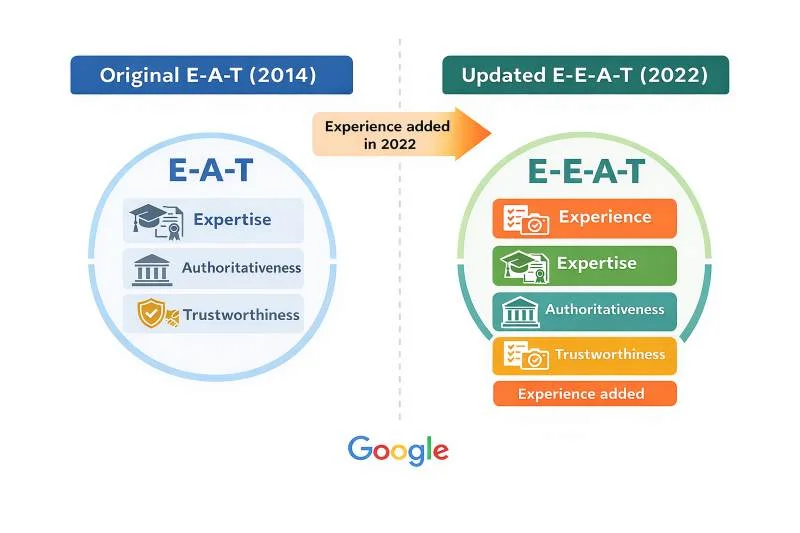
The concept behind the Google E-E-A-T guidelines originated in 2014 within Google’s Search Quality Rater Guidelines. Initially, the framework was known as E-A-T, representing:
Expertise
Authoritativeness
Trustworthiness
These principles were used by human quality raters to assess the credibility and quality of web pages. While E-A-T was not a direct ranking factor, it influenced how Google improved its search algorithms.
In December 2022, Google updated the framework and added another ‘E’ to highlight the importance of real-life experience This update transformed E-A-T into E-E-A-T. The inclusion of Experience emphasized the importance of first-hand or practical knowledge in content creation. For example, a product review written by someone who has personally used the product carries more value than one written purely from secondary research.
The evolution of the Google E-E-A-T guidelines reflects the broader shift in search engine optimization from technical manipulation toward genuine value and user-centric content.
SEO Before Google E-E-A-T Guidelines
.

Before the introduction of the Google E-E-A-T guidelines, SEO strategies were heavily focused on technical optimization and link-building tactics. Ranking high in search results often depended on measurable signals such as:
Keyword density
Exact-match anchor text
Backlink volume
Meta tags optimization
Internal linking structure
Page speed and crawlability
Although these elements remain important today, earlier SEO practices sometimes prioritized quantity over quality. Websites could achieve strong rankings by aggressively building backlinks or repeating keywords without necessarily providing meaningful or accurate information.
This environment created challenges, especially in sensitive categories like health, finance, and legal advice. Low-quality pages could rank well despite lacking genuine expertise or authority. The need for a stronger quality assessment model led to the refinement and reinforcement of the Google E-E-A-T guidelines
The Four Core Components of Google E-E-A-T Guidelines

The Google E-E-A-T guidelines are built around four foundational pillars. Each plays a distinct role in evaluating content credibility.
1. Experience
Experience refers to first-hand involvement with the topic. It answers questions such as:
Has the author personally used the product being reviewed?
Does the writer have direct experience with the situation discussed?
Is the content based on practical insight?
Experience adds authenticity. In modern content marketing, authentic reviews, case studies, and personal insights significantly enhance credibility.
2. Expertise
Expertise relates to subject-matter knowledge. This is especially critical in professional or technical fields such as:
Medical information
Financial advice
Legal guidance
Technical tutorials
Expertise can be demonstrated through qualifications, credentials, or detailed, accurate explanations supported by reliable sources.
3. Authoritativeness
Authoritativeness measures reputation and recognition within a specific industry. It may be reflected through:
Mentions from reputable websites
Strong backlink profile from trusted domains
Industry recognition
Established brand presence
Authoritativeness strengthens website credibility and supports long-term search visibility.
4. Trustworthiness
Trustworthiness is often considered the most important component of the Google E-E-A-T guidelines. Without trust, experience and expertise lose value.
Trust signals include:
Secure HTTPS connection
Clear contact information
Transparent editorial policies
Accurate, well-sourced content
Honest business practices
Trustworthiness reassures users that the information and the website itself are reliable.
Relationship Between Google E-E-A-T Guidelines and Search Algorithms
It is important to clarify that the Google E-E-A-T guidelines are not a direct ranking factor. Instead, they guide how Google evaluates content quality through algorithm updates and human quality raters.
Human evaluators use Search Quality Rater Guidelines to assess sample pages. Their feedback helps Google refine its ranking systems. Over time, algorithm updates have increasingly aligned with E-E-A-T principles.
This means websites that naturally demonstrate:
High-quality content
Strong expertise
Authentic experience
Clear trust signals
are more likely to achieve stable organic rankings.

Impact of Google E-E-A-T Guidelines on Modern SEO Strategy
The introduction and reinforcement of the Google E-E-A-T guidelines have reshaped SEO strategy significantly. Modern SEO is no longer limited to optimizing meta tags or acquiring backlinks. It now requires a holistic approach that includes:
Publishing in-depth, well-researched content
Displaying author bios with credentials
Updating outdated articles
Providing clear sourcing and citations
Maintaining editorial transparency
Strengthening brand authority
Content quality signals have become central to sustainable ranking growth.
Additionally, websites in YMYL categories face stricter evaluation. Demonstrating expertise and trust is essential in these niches.
Long-Term Significance of Google E-E-A-T Guidelines
The Google E-E-A-T guidelines represent a broader movement toward responsible information distribution. As artificial intelligence and automated content creation continue to grow, the importance of genuine expertise and real experience becomes even more critical.
In the long term, websites that align with E-E-A-T principles benefit from:
Higher user trust
Improved engagement metrics
Reduced algorithm volatility
Stronger brand reputation
Sustainable organic growth
Rather than chasing short-term ranking tactics, businesses are encouraged to build authority, credibility, and authentic expertise.
Develop Long-Term Industry Authority
Publish consistently within your niche
Authority does not grow from a single article. It develops when you repeatedly create high-quality, relevant content around related topics. Consistency helps search systems associate your site with a specific subject area and strengthens your overall reputation signals.
Cover topics in depth
Instead of writing shallow posts, aim to create comprehensive resources that answer multiple aspects of a subject. Detailed coverage improves informational value and supports subject authority.
Build recognition naturally
When other websites reference your work or mention your insights, your brand credibility increases. Mentions, citations, and genuine recommendations strengthen your external reputation.
Maintain topical focus
Jumping between unrelated subjects weakens your authority profile. Staying focused within a clear niche helps reinforce domain relevance and trustworthiness.
Align authority with credibility strategy
Developing long-term authority directly supports the broader goal of How to improve E-E-A-T for SEO because strong reputation and consistent expertise work together to build lasting search visibility.
Authority is not built overnight. It grows through reliability, depth, and sustained value over time.
How Google Developed E-E-A-T, Why It Was Created, and How It Changed SEO
Google did not create E-E-A-T overnight. The concept evolved over time as the internet expanded and the quality of online content became increasingly inconsistent. In the early years of search engine optimization, rankings were largely influenced by technical signals such as backlinks, keyword relevance, metadata optimization, and site structure. While these ranking systems helped organize content, they did not always guarantee accuracy or reliability.
As more websites competed for visibility, manipulative practices like keyword stuffing, artificial link building, and thin affiliate content began to affect search quality. Some pages ranked well despite lacking real expertise or credibility. This created a serious problem, especially in sensitive niches such as health, finance, and legal advice.
To improve search results, Google introduced structured quality evaluation standards within its Search Quality Rater Guidelines in 2014. That is when E-A-T (Expertise, Authoritativeness, Trustworthiness) was officially documented. Later, in December 2022, Google expanded it by adding “Experience,” transforming it into E-E-A-T.
If Google had not developed the E-E-A-T framework, search results could have become increasingly unreliable. The introduction of this model helped strengthen website credibility signals and align ranking systems with user trust.
Why Google Felt the Need to Create E-E-A-T
As digital publishing grew, Google noticed several patterns that threatened search quality:
Low-quality pages ranking through aggressive SEO tactics
Misleading medical and financial advice appearing in top results
Spam detection systems struggling to filter manipulative content
AI-generated or mass-produced content lacking depth
This was particularly dangerous in “Your Money or Your Life” (YMYL) categories, where inaccurate information could directly impact a person’s health, finances, or safety.
Google’s mission is to deliver helpful and trustworthy information. To maintain that standard, the company needed stronger content quality signals beyond technical optimization. Algorithm updates like Panda, Medic Update, and subsequent core updates gradually shifted focus toward expertise and authority.
E-E-A-T became a structured framework that helped human quality raters evaluate whether content demonstrated:
Real knowledge
Practical experience
Industry recognition
Clear trust signals
This shift encouraged responsible publishing rather than ranking manipulation.
Practical Application of E-E-A-T
Website owners and content creators can align with E-E-A-T principles by focusing on:
1. Demonstrating Experience
Publish case studies
Share personal insights
Provide original data or real examples
2. Showing Expertise
Include author credentials
Write in-depth, accurate content
Reference reliable sources
3. Building Authoritativeness
Earn backlinks from reputable sites
Establish industry recognition
Maintain consistent branding
4. Strengthening Trustworthiness
Use HTTPS security
Provide transparent contact details
Maintain editorial policies
Avoid misleading claims
For YMYL topics, these elements are even more critical.
Google did not announce E-E-A-T through a traditional product launch blog. Instead, it updated documentation within the Search Quality Rater Guidelines and reflected changes during major algorithm updates.
Today, E-E-A-T influences long-term ranking stability, brand authority, and user trust. It complements technical SEO, structured data, semantic search optimization, and content depth strategies.
Modern SEO is no longer just about keywords and backlinks It is about credibility, transparency, and value-driven publishing.
How Google Built and Implemented the E-E-A-T Framework
Google did not launch E-E-A-T as a single feature or tool. Instead, it developed the concept through continuous refinement of ranking systems and quality evaluation processes.
Research and Data Analysis
Google analyzed user behavior, search satisfaction signals, and content reliability trends. It studied how misinformation spreads and how users interact with search results.
Integration into Search Quality Rater Guidelines
In 2014, E-A-T was officially included in the Search Quality Rater Guidelines. Human evaluators were instructed to assess content based on expertise, authoritativeness, and trustworthiness.
Algorithm Alignment
Although E-E-A-T itself is not a direct ranking factor, Google aligns its algorithm updates with these principles. Systems such as:
Helpful Content System
Spam detection algorithms
Product Reviews System
Core ranking updates
work together to reward high-quality, people-first content.
Addition of “Experience” in 2022
In December 2022, Google added “Experience” to emphasize first-hand knowledge. For example, a travel guide written by someone who visited the location carries more value than one compiled from secondary sources.
Through continuous algorithm improvements and ranking system adjustments, Google embedded E-E-A-T principles into modern search evaluation. What Would Happen Without E-E-A-T and How to Apply It in Practice
Without the E-E-A-T framework, the search ecosystem could face serious challenges:
Low-quality medical advice ranking high
Financial scams gaining visibility
Fake product reviews influencing users
Reduced trust in search engines
E-E-A-T protects the integrity of search results by promoting accountability and credibility.